SureFlap vs PetSafe Microchip Cat Door: Which Locks Strays Out Better?
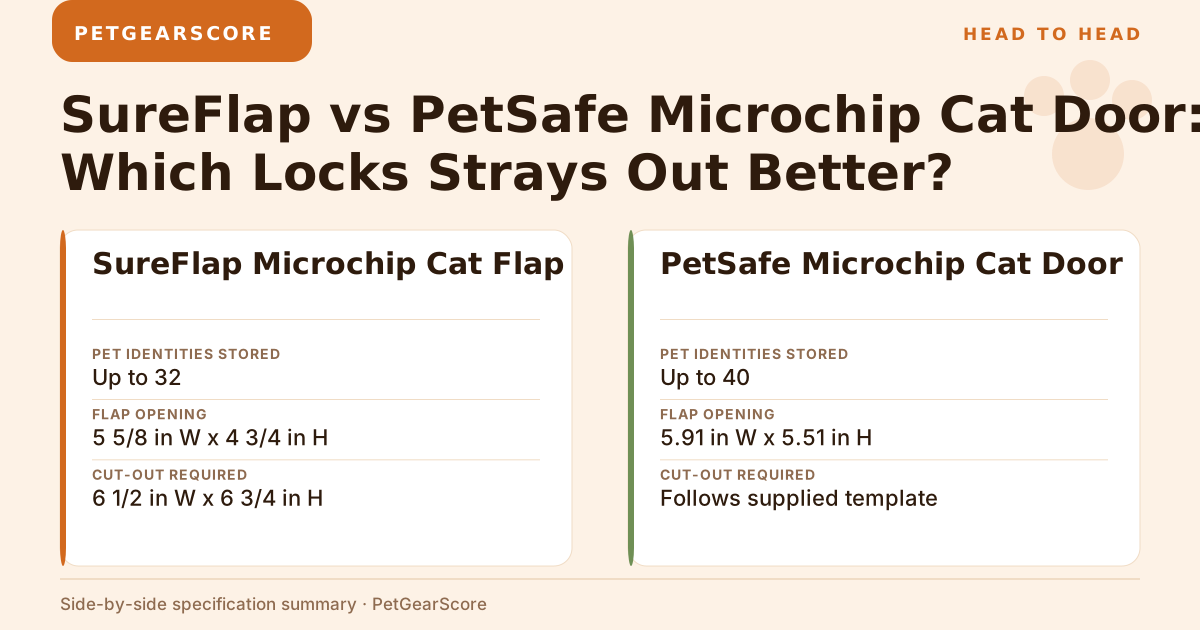
Both of these doors do the same core job: read your cat’s implanted microchip, unlock only for that chip, and leave the neighborhood tom standing outside. Where they diverge is in which chip formats they can read at all, how big the opening is, and whether there’s any path to app control. One of those differences can lock out your own cat, so it’s worth getting right before you cut a hole in your door.
Quick Answer
Buy the SureFlap Microchip Cat Flap if you don’t know exactly which microchip your cat has, if you’re installing into glass, or if you might want app control later — it reads 9-, 10-, and 15-digit chips and has a Connect version that adds a hub and remote locking. Buy the PetSafe Microchip Cat Door if you’ve confirmed your cat has a standard 15-digit FDX-B chip, you want the larger flap opening, and you have no interest in an app. PetSafe stores more pet identities and gives you a proper 4-way manual lock; SureFlap gives you broader chip compatibility and an upgrade path. For most buyers, chip format decides it.
SureFlap vs PetSafe: Spec Comparison
| Spec | SureFlap Microchip Cat Flap | PetSafe Microchip Cat Door |
|---|---|---|
| Microchip formats read | 9-digit (Avid Secure), 10-digit FDX-A, 15-digit FDX-B, plus SureFlap RFID collar tags | 15-digit FDX-B only (977 and 985 prefixes) |
| Pet identities stored | Up to 32 | Up to 40 |
| Flap opening | 5 5/8 in W x 4 3/4 in H | 5.91 in W x 5.51 in H |
| Cut-out required | 6 1/2 in W x 6 3/4 in H | Follows supplied template |
| Tunnel depth | 2 3/4 in | Tunnel extension sold separately for walls |
| Exterior frame | 8 1/4 x 8 1/4 in | Approx. 8.88 x 8.46 in |
| Locking | Manual lock with selective in-only entry | 4-way manual lock: locked, unlocked, in-only, out-only |
| Glass installation | Documented, circular hole 8 3/8 in optimal (up to 10 1/4 in) | Requires separate installation adaptor |
| Wall installation | Supported | Requires tunnel extension |
| Batteries | 4 x AA, rated up to 12 months | 4 x AA |
| App / connectivity | None on this model; Connect version adds hub and app | None, no upgrade path |
| Non-chipped cat option | SureFlap RFID collar tag | Microchip Cat Door Key, sold separately |
| Extras | Low battery indicator, memory retained without batteries | Dual magnetic latches, weather sealing, low battery indicator |
Microchip Compatibility Is the Real Decision
This is the row that should drive your purchase, and it’s the one buyers routinely skip.
Sure Petcare’s Microchip Cat Flap page states it reads 9-digit Avid Secure chips, 10-digit FDX-A chips, and the 15-digit FDX-B chips that are standard today. PetSafe’s Microchip Cat Door page narrows it to 15-digit FDX-B only — all numbers, no letters, read at 134.2 kHz.
If your cat was chipped in the last several years, almost certainly at a shelter or vet using an ISO-standard chip, PetSafe will read it fine and the compatibility question is moot. But older cats, rescues with unknown histories, and cats chipped in the US before ISO standardization took hold are a real population — and if your cat carries a 9- or 10-digit chip, the PetSafe door simply will not recognize it. Your cat stands at a door that never unlocks.
There’s a practical way to settle this before you buy: your vet can scan the chip and read you the number — the AVMA’s microchipping FAQ confirms pet chips carry a nine-, ten-, or fifteen-digit identification number and nothing else. Count the digits. Fifteen means both doors work. Nine or ten means SureFlap, no debate. It’s a five-minute phone call that prevents an expensive mistake, because once you’ve cut the hole, switching brands means the frames and cut-outs don’t necessarily line up.
One more wrinkle worth knowing: SureFlap also accepts its own RFID collar tags, which is the escape hatch for a cat with no chip at all, or a chip in an unreadable format. PetSafe sells a comparable key accessory separately. Either way, a collar-based key means a collar your cat has to keep wearing.
Keeping Strays Out: What Each Door Actually Does
Both doors work the same way at the security layer. The reader wakes when an animal approaches, scans for a chip it recognizes, and only releases the latch on a match. A stray with no chip gets nothing. A stray with a chip that isn’t in memory gets nothing. On that basic function, neither door has an advantage — a mismatch is a mismatch.
Where the differences show up is at the margins.
PetSafe’s 4-way lock is more flexible. Locked, unlocked, in-only, and out-only give you direct control without any app. In-only is the setting most owners use in the evening to bring a cat home and keep them there. Out-only is useful when you need to clear the house of cats before shutting the door for the night. SureFlap’s base model gives you a manual lock and selective entry, which covers the common cases but with fewer discrete modes.
Neither stops tailgating. If a determined stray follows your cat through while the flap is still swinging, no microchip door on the market prevents that. Owners with a persistent intruder problem — or raccoons, which are a different class of adversary entirely — should read our raccoon-proof pet door rankings, where physical latch strength matters more than chip reading.
PetSafe’s dual magnetic latches and weather sealing are a quiet advantage in windy locations. A flap that gets pushed open by a gust isn’t a security failure exactly, but it’s a draft and an invitation.
App Control, Curfews, and the Hub Question
Neither of the doors compared above has an app. If you want one, SureFlap is the only brand here with a path to it.
The SureFlap Microchip Cat Door Connect is the same flap with a radio inside, paired to a hub sold separately. Sure Petcare’s Cat Flap Connect page lists what that buys you: entry and exit notifications, a log of when your cat came and went, remote locking and unlocking from your phone, per-pet access permissions, and a curfew that locks and unlocks the door at set times. The curfew is the feature owners actually keep using — it enforces a “in by dark” rule without you being home to enforce it.
The cost is battery life. Sure Petcare rates the standard flap for up to 12 months on four AA cells and the Connect version at up to 6 months, which is the expected trade for keeping a radio alive. You also need the hub, which is an extra purchase and an extra thing plugged into your router.
PetSafe has no equivalent in this product. Worth being clear about one common mix-up: the PetSafe SmartDoor Connected is a different, higher-tier product with its own app and scheduling — we cover it in our PetSafe SmartDoor Connected review — and it is not an upgrade path for the basic Microchip Cat Door. If app control is on your list, decide that now, because you can’t add it to the PetSafe flap later. Our broader roundup of pet doors you can lock from your phone covers the field.
Installation and Fit
PetSafe has the larger opening: 5.91 by 5.51 inches versus SureFlap’s 5 5/8 by 4 3/4. That extra three-quarters of an inch of height is not nothing for a broad-chested or heavyset cat, and it’s the strongest argument for PetSafe beyond price.
SureFlap has the better-documented install range. Sure Petcare publishes exact figures for doors, walls, and glass, including the circular hole size for glass panels. PetSafe installs into wood, PVC, and uPVC out of the box, but glass, metal, and brick require a separate installation adaptor, and wall mounting needs a tunnel extension. Neither is difficult, but the accessories add cost and lead time, and they’re easy to overlook until the door is already apart.
Measure your cat before you measure the door. A cat’s shoulder width, not their weight, determines whether a flap is comfortable — and a cat who has to squeeze will start finding other ways in and out. If you want the full field rather than these two, our best microchip cat flap rankings and our in-depth SureFlap review go wider.
Current listings: SureFlap microchip cat flap, PetSafe microchip cat door, the Sure Petcare hub for the Connect version, and the PetSafe microchip cat door installation adaptor for glass or metal.
FAQ
Is SureFlap better than PetSafe for keeping strays out? For the actual locking mechanism, they’re equivalent — both stay shut for any chip not in memory. SureFlap’s advantage is that it reads more chip formats, so it’s less likely to lock out your own cat. PetSafe’s advantage is the 4-way manual lock, which gives you more direct control over direction of travel.
How do I know if my cat’s microchip will work with a PetSafe cat door? Ask your vet to scan the chip and read you the number. Fifteen digits beginning with 977 or 985 means PetSafe will read it. Nine or ten digits means you need SureFlap.
How many cats can each door hold? PetSafe stores up to 40 pet identities; SureFlap stores up to 32. Either is far beyond what a normal household needs, so this rarely decides a purchase.
Does the SureFlap cat door need Wi-Fi? The standard model doesn’t — it’s fully self-contained on batteries. Only the Connect version needs the separately sold hub to reach your network and enable the app, notifications, curfew, and remote locking.
Can I install a microchip cat door in glass? Yes for both, with a caveat. SureFlap publishes glass installation specs directly, including the circular hole diameter. PetSafe requires a separate installation adaptor for glass, metal, or brick. In both cases the glass itself has to be cut by a glazier — this is not a DIY drilling job on tempered glass.
How long do the batteries last? Both run on four AA cells. Sure Petcare rates the standard flap at up to 12 months and the hub-connected version at up to 6 months. Heavy traffic shortens both. Each door has a low battery indicator, and SureFlap retains its stored chip memory even with the batteries removed.
Conclusion
Treat this as a two-step decision. First, find out how many digits are in your cat’s microchip number — that single fact eliminates one of these doors for a meaningful share of households, and no other feature matters if the door can’t read your cat. If both are still in play, then choose on what you actually want from the door: PetSafe for the larger opening, the four locking modes, and a simpler unit with no accessories to buy; SureFlap for glass installs, wider format support, and the option to add a hub and a curfew down the line. Both keep strays out competently. Only one of them might keep your cat out too.