Petlibro Air vs Granary: Do You Actually Need the Camera Feeder?
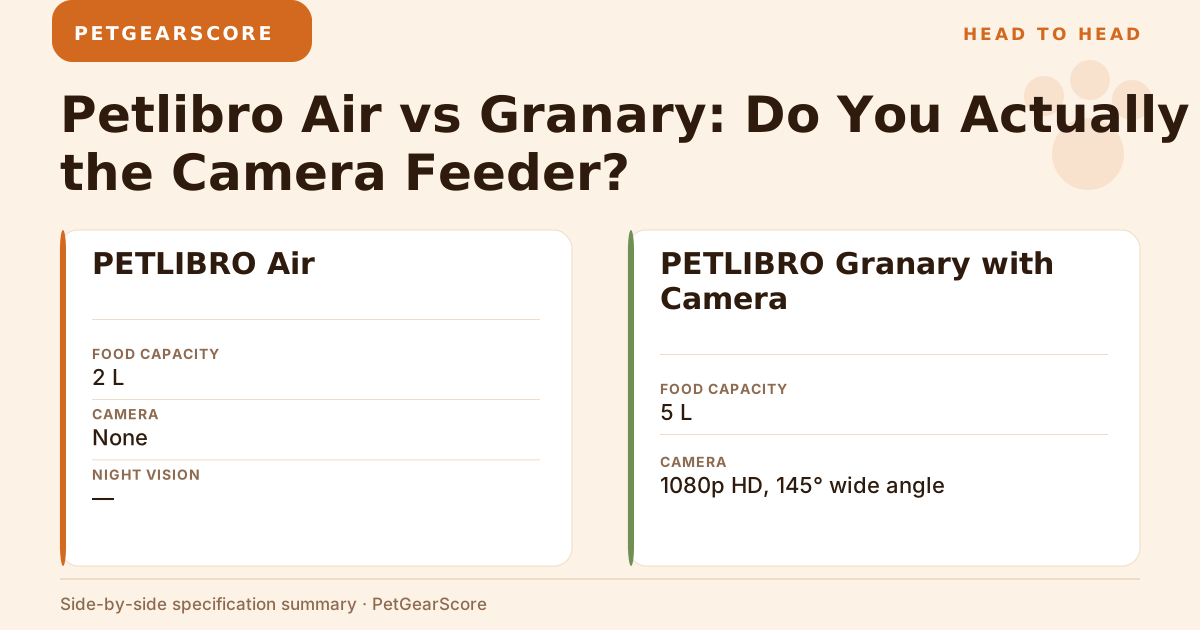
Petlibro makes both of these, they share an app, and they solve the same basic problem — but they solve it from opposite directions. The Air is a compact cordless feeder that goes anywhere. The Granary with camera is a bigger, plugged-in feeder that lets you watch your pet eat. Deciding between them is less about the camera than most shoppers expect.
Quick Answer
Get the Petlibro Air if you want the feeder somewhere without an outlet, you have one small-to-medium pet, or you just want reliable scheduled meals with app control — its 5200 mAh battery runs up to 30 days per charge and it holds 2 L of kibble. Get the Petlibro Granary with camera if you want to see and hear your pet while you’re out, you need the larger 5 L hopper, or you want two-way audio and motion alerts alongside feeding. The catch nobody mentions: the Granary’s camera only works while it’s plugged in, so choosing the camera means committing to a spot near an outlet.
Specs Side by Side
| Feature | PETLIBRO Air | PETLIBRO Granary with Camera |
|---|---|---|
| Food capacity | 2 L | 5 L |
| Camera | None | 1080p HD, 145° wide angle |
| Night vision | — | Yes, infrared |
| Two-way audio | No | Yes, real-time two-way voice |
| Motion / sound alerts | No | Yes |
| Video storage | — | MicroSD card, or optional cloud plans (7–30 days by tier) |
| Primary power | Built-in 5200 mAh rechargeable lithium battery | AC power adapter |
| Backup power | Battery is the primary source | D-cell alkaline batteries (not rechargeable) |
| Behavior on power loss | Keeps running normally | Emergency battery mode keeps feeding but disables Wi-Fi and camera |
| Battery life claim | Up to 30 days per charge | N/A — backup only |
| Wi-Fi | 2.4 GHz | Wi-Fi, app-connected |
| Bowl | Grade 304 stainless steel | Stainless steel (single-bowl model) |
| Meals per day | Up to 10 | Up to 10 |
| Portion range | App-scheduled portions | Up to 50 portions per meal (roughly 10 g / 20 ml each) |
| Kibble size | Dry food only | 2–15 mm / 0.07–0.6 in diameter |
| Wet food | No | No |
| App users | Up to 5 | App-connected |
| Multi-pet version | — | Dual food tray model available |
Do You Actually Need the Camera?
The camera costs you the cord
This is the trade the spec sheets bury. The Granary runs on an AC adapter, and its D-cell backup batteries exist for one purpose: keeping meals on schedule during a power cut. In that emergency mode, Wi-Fi and the camera shut off to conserve power. So the camera is not a feature you carry around — it’s a feature that lives permanently next to an outlet.
The Air inverts that entirely. Petlibro’s Air feeder collection is built around exactly this idea — cordless, rechargeable, no wall socket required — and a battery rated for up to 30 days per charge means the feeder goes wherever the pet actually eats: a laundry room, a spare bathroom, a corner of a bedroom, an awkwardly shaped apartment with three outlets total. It keeps full app control while running purely on battery, which is the part that matters — plenty of battery feeders lose connectivity the moment they’re unplugged.
If you have a cat that chews cords, that’s not a minor convenience. It’s the whole decision. For a broader look at how feeders handle outages and unplugged operation, see our guide to automatic pet feeders with battery backup.
What the camera is genuinely good for
Having said all that, there are situations where the camera earns its keep, and they’re more specific than “it’s nice to check in.”
Confirming the food actually landed. Every automatic feeder occasionally jams, bridges, or dispenses short. A schedule that says “fed at 6:00 p.m.” only tells you the motor turned. The camera tells you kibble came out and your cat ate it. For anyone who travels, that difference is worth real money.
Multi-pet food policing. If one pet inhales the other’s portion, the app log won’t show it — the video will.
Appetite changes. Motion and sound detection plus the 1080p night-vision footage Petlibro describes on its Granary camera feeder page means you can go back and see whether your pet approached the bowl and walked away. A drop in appetite is one of the first things Cornell’s Feline Health Center tells owners to take seriously in its feeding guidance, and timestamped video is the thing your vet can actually use.
Talking to an anxious pet. Two-way audio is either a genuine comfort or a source of confusion depending on the animal — some dogs settle at a familiar voice from nowhere, others get more agitated. It’s worth trying, not worth paying extra for sight unseen.
If those are your reasons, look at the wider field too — our roundup of automatic pet feeders with cameras covers the alternatives, and our full Granary review digs into the day-to-day of living with this one.
Capacity: 2 L vs 5 L is a refill-frequency question
The Granary holds two and a half times what the Air does. For a single cat on a normal portion schedule, 2 L is comfortably a couple of weeks of food and the smaller hopper keeps kibble fresher through faster turnover. For a medium or large dog, or for two cats, 2 L becomes a weekly chore and 5 L becomes the obvious answer.
Petlibro also sells a dual food tray version of the Granary camera feeder for two-cat households, which splits each dispense into two bowls. That’s a meaningfully different product from running one feeder and hoping the pets sort it out themselves.
Neither one does wet food
Worth stating plainly, because it’s the single most common returned-item complaint in this category: both the Air and the Granary are dry-food-only. The Granary specifies kibble between 2 and 15 mm in diameter — very large kibble or very small crumbly kibble will bridge in the hopper or jam the auger.
If your pet is on wet food, or on a mixed diet, neither of these is your feeder. That’s a different machine with a different mechanism, covered in do automatic pet feeders work for wet food and our picks for the best wet food automatic feeders.
FAQ
Is the Petlibro Granary camera feeder worth it over the Air? It’s worth it if you’ll actually use the camera — meaning you travel, you have multiple pets competing for food, or you’re monitoring a pet whose appetite you’re worried about. It is not worth it if the camera would just be a novelty you check twice and forget, because you’re also giving up the Air’s cordless placement and paying for a larger footprint. Buy the camera for a reason, not for the feature list.
Does the Petlibro Air need to be plugged in? No. It’s designed to run cordless on its built-in 5200 mAh lithium battery, rated for up to 30 days per charge, and it keeps app connectivity and scheduling while unplugged. That’s the whole point of the model.
Does the Granary camera still record if the power goes out? No. The Granary’s D-cell backup keeps the feeding mechanism running so your pet doesn’t miss meals, but emergency battery mode disables Wi-Fi and the camera. You’ll get fed pets and no footage — which is the right priority, but worth knowing before you rely on it as a security camera.
Do I need a subscription for the Granary’s camera? Not for basic use. Video records to a microSD card locally, and Petlibro offers optional cloud plans with retention windows ranging from about 7 to 30 days depending on the tier. If you’re allergic to recurring fees, run it on a card and skip the cloud entirely.
Can either feeder handle two cats? The Air’s 2 L hopper can feed two small cats, but you’re refilling often and both cats share one bowl. The better answer is the dual food tray Granary, which is built specifically for two-cat households and splits each dispense between two bowls. For the broader multi-pet problem — including microchip-gated options — our multi-cat feeder guide is the place to start.
Which one is better for a dog? The Granary, almost always. Dogs eat more per meal, so the 5 L hopper does real work, and the up-to-50-portions-per-meal range covers larger dogs that the Air’s smaller capacity would run through in days. The Air suits cats, kittens, and small dogs.
Do both work with the same app? Both are Petlibro app products with up-to-10-meals-a-day scheduling, feeding logs, and low-food alerts. The Air adds low-battery alerts (it needs them) and supports app access for up to five users, which is handy in a household where more than one person feeds the pet. Our app-controlled feeder roundup compares Petlibro’s app against the competition.
Conclusion
Frame this as a power question rather than a camera question and it resolves quickly. The Petlibro Air is the right buy when placement is the constraint — no outlet where the pet eats, a cord-chewing cat, a small apartment, one small-to-medium pet, and you’re happy with scheduled meals plus app logs. The Granary with camera is the right buy when visibility is the constraint — you travel, you’re managing two pets around one bowl, or you need to see whether a pet with a shaky appetite is eating.
Both are dry-food-only and both cap out at ten meals a day, so if wet food or unusual scheduling is your requirement, neither belongs on your shortlist. Otherwise, pick the constraint that actually applies to your home and skip the feature comparison entirely.